
Alternative
Best Ada Alternatives for Different Needs
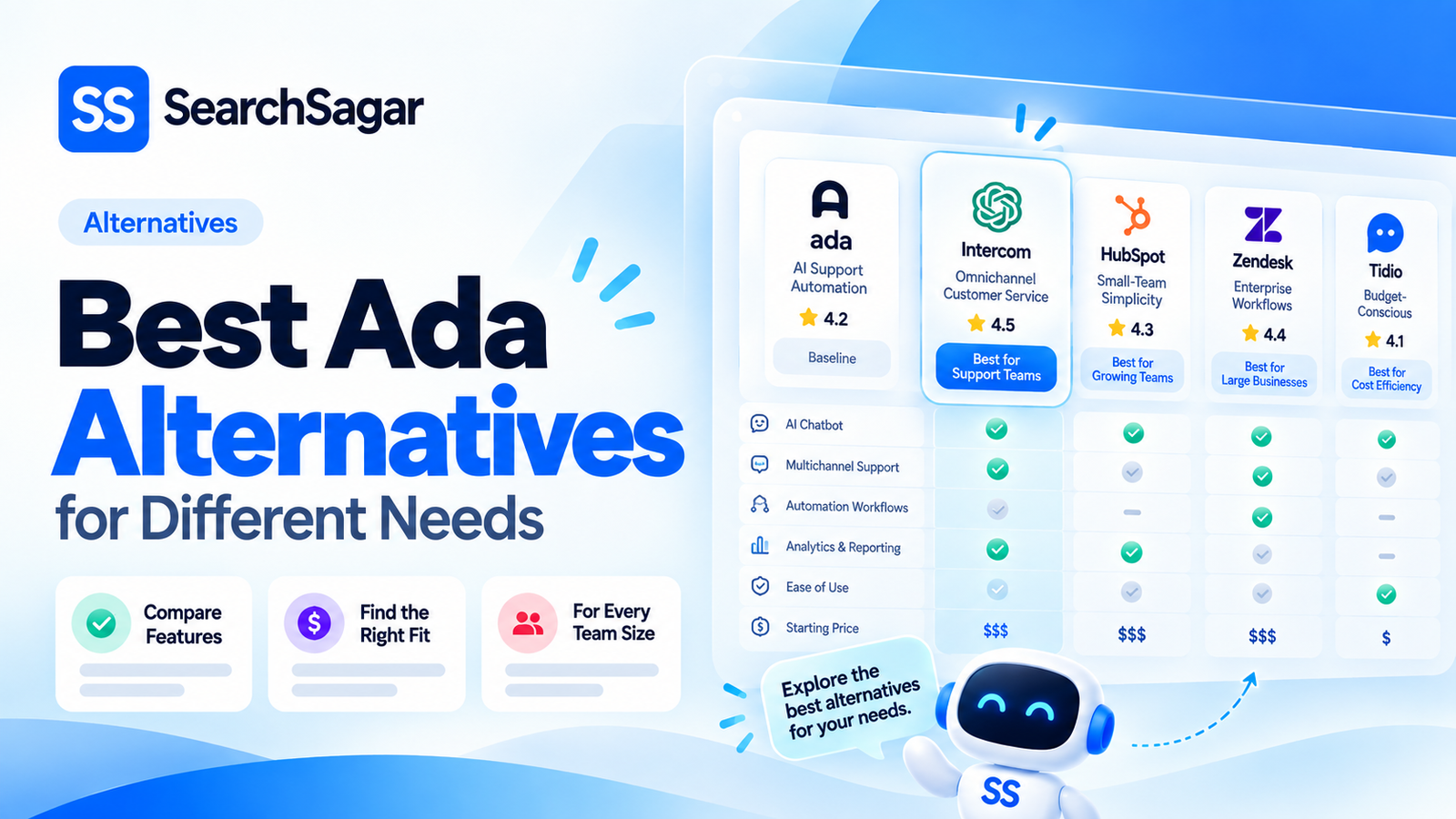
Compare Ada alternatives including Intercom Fin, Zendesk AI and HubSpot Customer Agent by features, pricing, workflows, integrations and best fit.
Ada is an enterprise AI customer service platform built around omnichannel AI agents, structured Playbooks, connected knowledge, external Actions, human handoffs, simulations, coaching, and performance management. It is a credible option for organizations that want one governed AI operating layer across messaging, email, and voice. The reasons to look for an Ada alternative are less about a missing core category feature and more about buying model, existing stack, and operational fit.
The biggest reason to compare alternatives is pricing transparency. Ada says conversation-based pricing is its primary model and supports resolution-based pricing for some enterprise requirements, but it does not publish numerical rates or included volumes. A second reason is platform gravity: a company already running Intercom, Zendesk, or HubSpot may get lower migration and integration friction by using the AI agent native to that ecosystem. A third reason is billing preference. Intercom publishes outcome pricing, Zendesk combines base service subscriptions with resolution usage, and HubSpot uses a clear credit model for its Customer Agent.
For this comparison I evaluated three alternatives that already exist as published Tool records in SearchSagar: Intercom Fin, Zendesk AI, and HubSpot Breeze/Customer Agent. I compared customer-service fit, workflow automation, channels, handoffs, pricing structure, implementation considerations, and current official documentation rather than treating one product as the universal winner.
Quick verdict
Key takeaways
- Ada is strongest when enterprise governance, Playbooks, Actions, simulations, and omnichannel operation matter most
- Intercom Fin offers the most visible standalone AI-agent unit price among these options at $0.99 for most published outcomes
- Zendesk AI is tightly integrated with Zendesk's service platform and prices base seats publicly while AI-agent usage is resolution-based
- HubSpot Customer Agent combines CRM context with a transparent credit model and is most attractive to existing HubSpot customers
- The right alternative depends more on your current support stack, billing preference, and workflow complexity than on a single feature checklist
Enterprise AI customer service agents for omnichannel support
Best for: Mid-market and enterprise customer experience teams that want to automate high support volumes across messaging, email and voice while retaining structured workflows, human escalation and governance.
- Omnichannel AI Agents
- Performance Management
- Playbooks
- Email AI Agent
- Simulations and Testing
- G2 reviewers frequently highlight Ada's clean interface, straightforward administration and relatively easy Playbook creation.
- Combines messaging, email and voice AI agents under one customer-service platform rather than treating each channel as a separate product.
- Playbooks, actions, knowledge and handoffs provide structured control over complex workflows instead of relying only on open-ended generation.
- Ada does not publish numerical pricing, minimum contract values or included conversation volumes, making budget comparison difficult before a sales process.
- G2 reviewers mention pricing as a concern for some buyers, reinforcing that Ada is better suited to organizations with meaningful automation volume and budget.
Affiliate link — we may earn a commission.
Why look for an Ada alternative?
Ada's strengths are substantial: it can operate across messaging, email, and voice; use structured Playbooks and Actions; ground responses in enterprise knowledge; escalate to human teams; and support testing and ongoing improvement. The case for an alternative starts when one of those strengths is less important than another constraint.
Pricing transparency is the first constraint. Ada's numerical price is custom. Buyers that need a fast cost model may prefer Intercom's published per-outcome rate, Zendesk's published seat pricing, or HubSpot's published credit mechanics.
Existing platform investment is the second. If the support organization already uses Zendesk extensively, adopting Zendesk AI can preserve agent workflows, reporting, ticketing, knowledge, and administrative controls. If the organization uses HubSpot CRM and Service Hub, Customer Agent can operate close to customer records, tickets, and CRM data. If Intercom is already the customer-service workspace, Fin is the obvious native path.
Commercial metric preference is the third. Ada emphasizes conversation-based pricing for most customers. Some buyers prefer paying when an AI agent delivers a defined outcome or resolution. Intercom's Fin model is explicitly outcome-based, Zendesk measures AI-agent usage with resolution allowances and tiered outcomes, and HubSpot consumes credits when Customer Agent delivers a resolution.
Pros
- Omnichannel AI agent across messaging, email, and voice
- Structured Playbooks, Knowledge, Actions, and human handoffs
- Strong simulation, coaching, and governance workflow
Cons
- Numerical pricing is not publicly disclosed
- Enterprise implementation can require significant process and integration work
- Buyers already standardized on another service platform may prefer its native AI agent
How we selected the alternatives
I limited the shortlist to products in the same customer-support AI use case that already have SearchSagar Tool records and valid Product IDs. That avoids presenting a generic AI tool as a substitute simply because it ranks for an alternatives keyword. Each selected product can answer customer questions, connect to service workflows, escalate to humans, and operate as part of a broader support stack.
I reviewed current official product and pricing material for Ada, Intercom, Zendesk, and HubSpot. Pricing comparisons use vendor-published figures where available and clearly identify custom or usage-based elements. SearchSagar ratings are only shown when stored in the Tool record; the three alternatives do not currently carry SearchSagar editorial ratings in the supplied CSV, so they are marked Not yet rated rather than being scored here.
No unsupported hands-on testing is claimed. The analysis focuses on documented capabilities, commercial mechanics, and recurring Ada user-feedback patterns from G2 and Capterra. Actual fit should be validated with a representative workflow, especially for integrations, languages, handoff behavior, and AI-resolution definitions.
Testing methodology
Best Ada alternatives at a glance
| Product | Best for | Starting price | Free plan | SearchSagar rating | Key advantage |
|---|---|---|---|---|---|
| Ada | Enterprise omnichannel AI customer service | Contact sales | No public permanent free plan | 4.2 | Playbooks, Actions, testing, coaching, and governance in one AI-agent platform |
| Intercom Fin | Teams wanting public outcome pricing or Fin on an existing helpdesk | $0.99 per most Fin outcomes | No permanent Fin free plan | Not yet rated | Transparent outcome price and flexible helpdesk deployment |
| Zendesk AI | Organizations already operating on Zendesk | Support Team $19 per agent/month yearly; Suite Team $55 per agent/month yearly | No permanent paid-suite free plan | Not yet rated | Native AI agents inside a mature service and ticketing platform |
| HubSpot Customer Agent | HubSpot-centric service and CRM teams | Eligible HubSpot subscription plus credits | HubSpot has free tools, but Customer Agent deployment requires eligible paid subscription | Not yet rated | CRM-native context with published credit consumption |
1. Intercom Fin — Best for transparent outcome pricing
Why consider this alternative?
Intercom Fin is the closest alternative in this shortlist for a buyer primarily interested in an autonomous customer-service AI agent rather than an entire CRM suite. Fin can answer customer questions, use knowledge, take actions, participate in workflows, and hand conversations to humans. It can run as part of Intercom's customer-service platform or, for supported environments, alongside an existing helpdesk without requiring Intercom seats.
The main difference from Ada is pricing visibility. Intercom publishes $0.99 for most Fin outcomes, including resolutions, procedure handoffs, disqualifications, and self-serve routing. It also publishes the Intercom seat prices when Fin is paired with the native helpdesk: Essential at $29 per seat per month, Advanced at $85, and Expert at $132 on the pricing page currently surfaced with annual billing. For Fin on an existing helpdesk, Intercom says no seats are required, although minimum commitments apply.
Fin is best for teams that want a dedicated AI service agent, a visible usage metric, and a relatively direct path to deployment in an existing support stack. Its important limitation is that $0.99 is not the only possible cost: Intercom seats, Pro or Copilot add-ons, WhatsApp, SMS, phone, outbound messaging, or other usage charges can affect the final bill. Buyers also need to understand what Intercom counts as an outcome.
AI customer agent for service, sales and ecommerce across Intercom or existing helpdesks
Best for: Customer-service organizations that want a no-code AI agent to resolve questions, execute support procedures, qualify buyers and hand off to humans across Intercom or an existing helpdesk.
- Multilingual Support
- Existing Helpdesk Deployment
- Fin for Sales
- Train, Test, Deploy and Analyze
- Image Understanding
- G2 reviewers frequently praise Fin's ease of setup and its ability to answer quickly from existing support documentation.
- Fin can operate across service, sales and ecommerce roles rather than being limited to a narrow FAQ chatbot.
- Teams can train, test, deploy and analyze Fin in one no-code workspace, with procedures and actions controlling how the agent behaves.
- G2 reviewers report that Fin can occasionally provide incorrect, irrelevant or confusing answers, particularly on complex or ambiguous queries.
- USD 0.99 per successful outcome can become expensive or less predictable as support volume and automation rates grow.
Affiliate link — we may earn a commission.
Key features
Feature Breakdown
Fin answers and resolves customer issues with published outcome billing
Combines AI handling with structured automation and configured handoff paths
Can take approved actions on connected systems rather than only generating answers
Escalates based on customer requests, rules, guidance, or workflow logic
Pros and cons
Pros
- Public $0.99 price for most Fin outcome types
- Can run with Intercom or supported external helpdesks
- Strong workflow and escalation controls
Cons
- Total cost can include seats, add-ons, channels, and usage beyond Fin
- Minimum commitments apply for Fin on existing helpdesks
- Outcome definitions require careful commercial review
Pricing
Intercom currently prices most Fin outcomes at $0.99. A qualification outcome in Fin for Sales is priced differently at $9.99, which shows why teams should compare the exact use case rather than repeating one headline number. When Fin is used with Intercom, customer-service plans add per-seat pricing. When Fin runs on an existing helpdesk, Intercom states that no seat costs or platform fees apply, but a minimum commitment is required.
Intercom also lists optional costs such as Pro from $99 per month, Copilot at $29 per agent per month, and usage charges for some communication channels. The public visibility is still materially better than Ada's custom numerical pricing, but procurement should build a total model.
Best for
Who should use this
- Support teams that want an AI agent with a public per-outcome price
- Companies that want Fin on an existing helpdesk without migrating the entire service platform
- Intercom customers that want AI, workflows, inbox, ticketing, and human support in one system
Who should avoid it?
Who should avoid this
- Teams that dislike outcome-based billing definitions
- Buyers whose channel and add-on usage would make the total Intercom stack expensive
How it compares with Ada
Intercom is easier to price before talking to sales. Ada is stronger in the way SearchSagar's current product research frames structured enterprise AI operations: Playbooks, simulations, Coaching, and a dedicated ACX governance model are central to the product story. Intercom Fin has its own workflows, reporting, and quality tooling, but a buyer focused on enterprise AI-agent governance should compare those management layers directly rather than assuming identical depth.
I would choose Fin over Ada when public outcome pricing, existing-helpdesk deployment, or deep Intercom alignment matters more than Ada's broader enterprise AI-agent operating model. I would keep Ada in front when the requirement emphasizes Playbooks, complex omnichannel procedures, simulations, and a dedicated governance workflow.
2. Zendesk AI — Best for existing Zendesk service organizations
Why consider this alternative?
Zendesk AI is the natural Ada alternative for organizations that already use Zendesk as the center of customer service. Rather than introducing a separate AI-agent platform and integrating it into ticketing, knowledge, routing, analytics, and human workflows, Zendesk embeds AI agents inside its Resolution Platform. Current AI-agent material emphasizes end-to-end resolution across messaging, email, voice, and other service environments, with actions across connected systems and automated quality controls.
Zendesk also has the advantage of visible base subscription pricing. Support Team starts at $19 per agent per month when paid yearly, and Suite Team is $55 per agent per month yearly. The Suite tier adds AI Agents, Knowledge Base, Action Builder, omnichannel routing, messaging, live chat, and telephony. AI-agent usage itself is not simply unlimited inside that seat price: Zendesk uses resolution allowances and outcome-based measurement, and customers can purchase more allowance.
The most important limitation is pricing complexity. A buyer needs to separate the base service plan, AI-agent resolution usage, Copilot, and other potential additions. Copilot is a separate add-on, even though AI agents are included in current Suite and Support plans.
AI agents and copilots built into Zendesk service workflows
Best for: Established customer service teams that want AI agents, omnichannel ticketing, knowledge, workflow automation, and human-agent assistance in one service platform.
- Knowledge Base
- AI Writing Tools
- Admin Copilot
- AI Agents
- App Builder
- G2 users frequently praise Zendesk for consolidating email, messaging, social, chat, and other support interactions into one workspace.
- AI Agents and Copilot combine customer-facing automation with assistance for human agents and administrators.
- Strong workflow flexibility through automations, Action Builder, APIs, and a large integration ecosystem.
- Total cost can increase beyond the base seat price because AI-agent resolutions, add-ons, and some consumption-based features are billed separately.
- G2 reviewers commonly report a learning curve for advanced workflows, administration, customization, and reporting.
Affiliate link — we may earn a commission.
Key features
Feature Breakdown
Customer-facing agents for complex multi-step resolutions across service channels
Grounds AI responses in help-center and connected content
Connects automated service to business workflows and external systems
Keeps AI agents, human agents, ticketing, routing, analytics, and QA in one service environment
Pros and cons
Pros
- Strong fit for organizations already using Zendesk
- Public base seat pricing makes procurement easier to start
- AI agents connect directly with Zendesk ticketing, knowledge, routing, and human teams
Cons
- AI-agent usage adds resolution economics beyond the seat price
- Copilot is a separate add-on
- Packaging and usage rules require careful account-specific review
Pricing
Zendesk currently lists Support Team at $19 per agent per month paid yearly and Suite Team at $55 per agent per month paid yearly. Suite Professional is $115 per agent per month yearly. Zendesk says AI agents are included in every Suite and Support plan, with usage priced according to successful outcomes. Accounts receive a resolution allowance, and additional allowance can be purchased.
This makes Zendesk more transparent than Ada at the base-platform level, but buyers still need an account-specific calculation for AI resolution volume. If the organization also wants human-agent Copilot, that is a separate add-on rather than part of the AI-agent entitlement.
Best for
Who should use this
- Existing Zendesk customers that want AI agents without changing the core service platform
- Teams that need ticketing, omnichannel routing, knowledge, telephony, and AI in one service suite
- Organizations that want public base seat pricing before modeling AI usage
Who should avoid it?
Who should avoid this
- Teams that do not want to center customer service on Zendesk
- Buyers looking for a single simple all-in AI price without separate resolution economics or add-ons
How it compares with Ada
Zendesk's largest advantage is platform consolidation. Ada can integrate with Zendesk and hand conversations to it, but Zendesk AI removes the boundary between the AI layer and the service platform for organizations already committed to Zendesk. That can simplify ticket context, routing, human escalation, knowledge administration, and reporting.
Ada remains differentiated by its AI-agent-centric operating model, especially the prominence of Playbooks, simulations, Coaching, and the ability to position Ada as an AI layer across an existing service ecosystem. I would favor Zendesk AI when minimizing platform sprawl is a priority and Zendesk is already strategic. I would keep Ada in the comparison when the organization wants a dedicated AI customer-experience platform that can sit across channels and systems.
3. HubSpot Breeze Customer Agent — Best for CRM-centric service teams
Why consider this alternative?
HubSpot's Customer Agent, part of its broader AI offering historically branded around Breeze and now presented through Agent Hub, is a credible Ada alternative for organizations whose customer data and service processes already live in HubSpot. The agent can answer questions from connected content, use CRM context, perform supported actions, qualify leads, and hand conversations to human agents. HubSpot also provides testing, performance analysis, and agent insights for ongoing improvement.
The pricing model is more transparent than Ada's. Eligible HubSpot subscriptions include a monthly credit allotment, and Customer Agent consumes 50 HubSpot Credits when it delivers a qualifying resolved conversation. HubSpot currently prices credits at $0.01 each, making that published credit consumption equivalent to $0.50 per resolved conversation after included credits. The customer-service subscription still matters: Service Hub Professional currently starts at $90 per seat per month on annual billing and requires a $1,500 one-time onboarding fee; Enterprise starts at $150 per seat per month with a $3,500 onboarding fee.
The main limitation is ecosystem dependency. Customer Agent is most compelling when HubSpot is already the CRM and service platform. For a company running a different enterprise helpdesk, adding the necessary HubSpot subscription purely for the AI agent may be less attractive than Ada or Fin.
HubSpot AI for CRM-grounded assistance, agents, research and go-to-market automation
Best for: Organizations already using HubSpot that want AI assistance and agents grounded directly in CRM, customer, sales, marketing and service data.
- Breeze Assistant
- Mobile Breeze Assistant
- Agent Builder
- Data Agent
- Prospecting Agent
- Breeze Assistant is included with every HubSpot subscription and uses CRM and customer context rather than operating as a disconnected generic chatbot.
- HubSpot now publishes clear outcome rates for key agents: Customer Agent at USD 0.50 per resolved conversation, Data Agent at USD 0.10 per answer and Prospecting Agent at USD 1 per recommended lead.
- Agent builder lets teams create custom agents from natural-language instructions, existing CRM data, tools and organizational knowledge without conventional coding.
- Breeze is not one independently priced product, so total cost can be difficult to compare because HubSpot subscription editions, seats, add-ons and credits all matter.
- AI-agent usage can scale quickly: Customer Agent, Prospecting Agent, Data Agent and custom-agent actions consume credits or outcome-based usage.
Affiliate link — we may earn a commission.
Key features
Feature Breakdown
Uses connected HubSpot content and customer context to answer questions
Consumes credits when the agent delivers a qualifying resolution
Escalates to humans and can complete supported service actions
Lets managers review sources, actions, knowledge gaps, and agent performance
Pros and cons
Pros
- Tight integration with HubSpot CRM and Service Hub
- Published credit price and 50-credit Customer Agent resolution cost
- Fourteen-day free access is available to eligible first-time Customer Agent setups
Cons
- Requires an eligible paid HubSpot subscription to deploy Customer Agent
- Professional and Enterprise onboarding fees add to first-year cost
- Credit usage stops new assignments when capacity is exhausted unless more credits are added
Pricing
HubSpot Service Hub has a free tier, but current Customer Agent deployment documentation requires eligible Professional or Enterprise subscriptions. Service Hub Professional starts at $90 per seat per month on annual billing and includes 3,000 credits, while Enterprise starts at $150 per seat per month and includes 5,000 credits. HubSpot credits cost $0.01 each, and Customer Agent consumes 50 credits when a conversation is resolved under HubSpot's current definition.
HubSpot also offers 14 days of free access to Customer Agent for eligible first-time setups, during which the agent does not consume credits. Buyers should include mandatory onboarding fees for higher Service Hub tiers and model whether included credits cover normal monthly resolution volume.
Best for
Who should use this
- HubSpot customers that want AI support grounded in CRM and service data
- Revenue and service teams that want one customer record across marketing, sales, and support
- Buyers that prefer a published credit model and can forecast resolved-conversation volume
Who should avoid it?
Who should avoid this
- Organizations that do not use HubSpot and would need a new CRM or service subscription mainly for the AI agent
- Buyers that want conversation-based billing instead of resolution-based credit consumption
How it compares with Ada
HubSpot is easier to quantify because the credit price and Customer Agent consumption are public, and it can be operationally simpler for existing HubSpot teams. Ada is more specialized as an enterprise AI customer-service platform and offers a broader AI-agent management story across messaging, email, voice, Playbooks, simulations, coaching, and external systems.
I would choose HubSpot Customer Agent when CRM context and a consolidated HubSpot revenue stack are major advantages. I would prefer Ada when the support organization needs a dedicated, cross-platform AI service layer and is prepared for a more involved enterprise implementation and quote process.
Feature comparison
| Feature | Ada | Intercom Fin | Zendesk AI | HubSpot Customer Agent |
|---|---|---|---|---|
| Messaging support | Yes | Yes | Yes | Yes |
| Email AI support | Yes | Yes | Yes | Yes |
| Voice AI | Yes | Available; voice pricing can require sales discussion | Yes | Not the primary documented Customer Agent deployment focus |
| Structured workflow automation | Playbooks and Actions | Workflows and Procedures | AI procedures, Action Builder, workflows | Guidelines, actions, workflows, CRM automation |
| Human handoff | Yes, with enterprise CX integrations | Yes, configurable through guidance, rules, and workflows | Yes, native to Zendesk service routing | Yes, configurable handoff process |
| Testing and optimization | Simulations, conversation review, Coaching | Preview, reporting, quality and workflow controls | Built-in QA, analytics, agent management | Testing, agent insights, performance analytics |
Pricing comparison
| Product | Starting price | Free plan | Best-value plan | Important cost factor |
|---|---|---|---|---|
| Ada | Contact sales | No public permanent free plan | Custom enterprise quote matched to forecast volume | Conversation allowance, overage, implementation, and renewal terms |
| Intercom Fin | $0.99 per most outcomes | No permanent Fin free plan | Fin on existing helpdesk when seats are not needed | Minimum commitment plus any channels or add-ons |
| Zendesk AI | $19 per agent/month yearly for Support Team; $55 for Suite Team | No permanent paid-suite free plan | Existing Zendesk customers using included AI-agent access | Resolution allowance and any Copilot or higher-tier needs |
| HubSpot Customer Agent | Eligible HubSpot subscription plus credits | HubSpot free tools exist; Customer Agent deployment requires eligible paid plan | Existing Professional or Enterprise customers with included credits | 50 credits per resolved conversation, onboarding fees, and seat costs |
Best alternatives by use case
For transparent AI-agent unit pricing: Intercom Fin
Intercom publishes the clearest headline AI-agent price in this group: $0.99 for most Fin outcomes. That makes it easier to build a first-pass cost model before engaging sales. The important caveat is to include any minimum commitment, Intercom seats, channel usage, and add-ons required by your deployment.
For an existing Zendesk organization: Zendesk AI
If Zendesk already owns your ticketing, knowledge, routing, agent workspace, and reporting, its AI agents can reduce integration and operational fragmentation. The decision then becomes whether Zendesk's resolution economics and AI controls meet your needs, not whether you should add another service platform.
For a HubSpot CRM organization: HubSpot Customer Agent
HubSpot is attractive when support needs CRM context and the company already pays for eligible HubSpot tiers. Customer Agent's 50-credit resolution consumption is easy to model, and the first-time 14-day free-access period gives eligible teams a practical way to evaluate it without consuming credits.
For structured enterprise AI-agent governance: Ada
Ada remains the strongest fit in this shortlist when the organization specifically wants Playbooks, Actions, simulations, Coaching, omnichannel AI agents, and an AI-centric governance model that can sit alongside established enterprise systems. Its weakest point remains the absence of public numerical pricing.
What users say about switching
Available Ada reviews provide useful reasons to compare alternatives, but they do not justify claiming a universal migration pattern. G2's current summary highlights positive sentiment around ease of administration, Playbooks, onboarding, customization, and support, while also surfacing pricing, reporting categorization, security-related updates, and integration workflows as concerns for some users.
Capterra's smaller review set includes positive comments about ease of use, support, and automation value, alongside concerns such as localization friction, manual flow work, and the time required to add channels or integrations. One negative review explicitly preferred a prior Intercom experience, but that is an isolated opinion and should not be generalized.
The useful takeaway is to turn those complaints into evaluation tests. If pricing is the concern, compare normalized annual cost. If reporting is the concern, reproduce the dashboards and classifications your managers need. If integrations are the concern, build the actual handoff and action path. If multilingual service is critical, test your real languages rather than relying on a language-count claim.
Expert tip
Expert tip
— SearchSagar editorial team
How to choose the right Ada alternative
- List non-negotiable service journeys. Separate simple knowledge questions from workflows that require authentication, actions, multiple steps, or regulated escalation.
- Quantify team size and annual conversation volume. Seat-based, conversation-based, outcome-based, and credit-based models can reverse the apparent price ranking at different scales.
- Define the billing event. Ask exactly what counts as a conversation, resolution, outcome, or credit-consuming action.
- Map required integrations. Verify knowledge ingestion, CRM data, ticket creation, live handoff, asynchronous handoff, identity, and business-system actions separately.
- Model migration work. Moving a chatbot is not only moving content. Procedures, intents, actions, reporting, analytics, and escalation rules may need to be rebuilt.
- Review security and compliance. Confirm certifications, data retention, model-provider policies, regional requirements, access controls, audit logs, and contractual data terms for your industry.
- Test human escalation. The best AI answer is irrelevant if the customer reaches a dead end when automation fails. Test context transfer and routing with actual agents.
- Calculate total cost. Include seats, AI usage, channels, onboarding, implementation, integrations, add-ons, overages, taxes, and renewal increases.
- Check contract flexibility. Compare minimum commitments, annual prepayment, renewal notice, refunds, and the treatment of unused usage.
- Run a representative trial or pilot. Measure resolution, repeat contact, handoff, CSAT, latency, and operational effort on the same scenarios across finalists.
When should you stay with Ada?
Stay with Ada when your team has already invested in Playbooks, Knowledge, Actions, handoffs, simulations, and operational coaching and those workflows are performing well. Rebuilding a mature automation estate in another product can create migration cost, temporary quality loss, and retraining work that outweighs a modest subscription saving.
Ada also remains attractive when you need one dedicated AI-agent layer across multiple service systems and channels. If changing the underlying helpdesk is not desirable, Ada's integrations and developer tooling can be an advantage over adopting a competitor whose value depends on moving the entire support operation into its ecosystem.
Finally, do not switch only because another vendor publishes a lower unit price. The relevant metric is cost per successful customer outcome after human rework, escalation, seats, implementation, channels, and support are included. If Ada produces stronger automation quality in your environment, a higher-looking unit price can still deliver a lower total service cost.
Final verdict
There is no universal Ada replacement because the three strongest alternatives solve the buying problem from different platform positions. Intercom Fin is the most direct alternative for teams that want an AI customer-service agent with transparent outcome pricing and the ability to run either inside Intercom or with an existing helpdesk. Zendesk AI is the logical choice for organizations already committed to Zendesk and looking to keep AI agents, human service, ticketing, routing, knowledge, and quality management inside one service platform. HubSpot Customer Agent is the best fit for companies that want AI support tightly connected to HubSpot CRM and prefer a published credit model.
Ada should remain on the shortlist when structured enterprise automation is the priority. Its Playbooks, Actions, Knowledge, simulations, Coaching, human handoffs, and omnichannel AI-agent model create a strong governance story for complex CX operations. Its principal disadvantage is that buyers need a quote before they can make a serious cost comparison.
Before switching, verify the same real workflows in each finalist and normalize the economics to the same support volume. The platform that looks cheapest on a pricing page may not be cheapest after seats, outcomes, credits, integrations, onboarding, migration, and human rework are included.